There’s something about no-knead focaccia that gets people excited. Maybe it’s the fantasy of a “magic dough” — one you mix with a spoon, leave to rest, and it somehow transforms into a bubbly, beautiful masterpiece.
But let’s be honest: this isn’t really a “set it and forget it” recipe. It’s just based on a different principle — letting time do the work.
So what’s the secret? A little understanding of gluten.
Gluten, as I like to remind people, develops in two main ways: either by kneading it a lot (think brioche, babka, or bagels), or by simply giving it enough time and moisture. That’s why many professional recipes begin with autolyse — mixing only the flour and water, and letting the dough rest. Even without kneading, a gluten network starts to form.
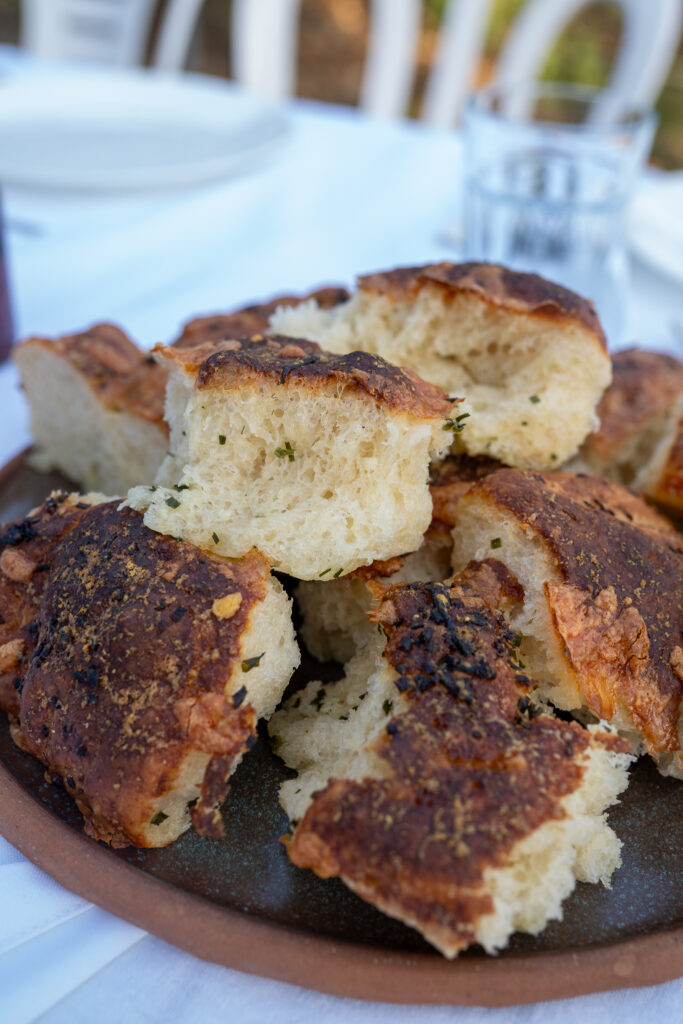
Another way to build gluten is through folding — a technique often used in sourdough bread. Instead of kneading, you gently fold the dough during the bulk fermentation. It might sound technical, but it’s actually a soft, intuitive motion that strengthens the dough’s internal structure.
You lift one side of the dough, stretch it gently upward, then fold it over itself. The proteins align, the bonds strengthen — and the dough starts changing before your eyes. Less sticky, more elastic, with structure you can actually feel.
So yes, no-knead focaccia doesn’t involve classic kneading — but it’s definitely not a “hands off” recipe either. The folding process is key, and it’s worth getting to know.
And hey — if you’re not following me on Instagram yet, now’s the time 😉
What’s the Best Flour for No-Knead Focaccia?
As with all baking, flour choice matters. If you have a bread flour or a flour labeled “focaccia flour,” use it. These flours are higher in protein, which means more gluten potential. That’s what helps the dough rise beautifully and hold its shape, resulting in that soft, springy texture we love.
Only have all-purpose flour? Totally fine — the focaccia will still turn out tasty. The texture might be a little more cakey, a little less chewy, but still great. Bread flour is a small upgrade that makes a noticeable difference.
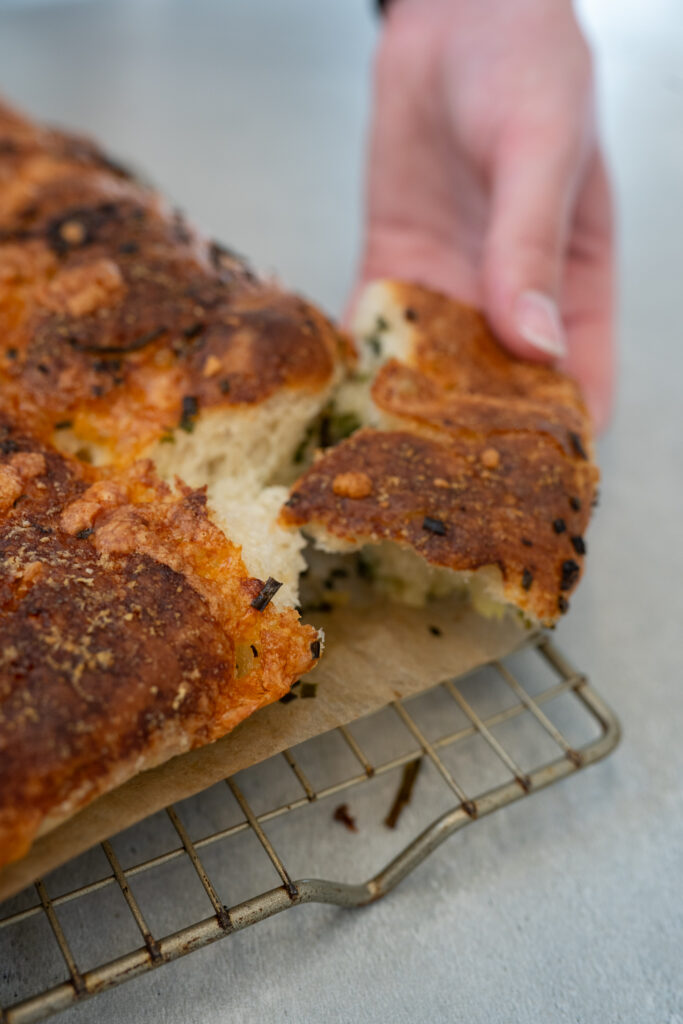
How to Fold the Dough
After mixing all the ingredients with a wooden spoon, you’ll end up with a shaggy, wet, lumpy dough — not at all what you’d expect from something that’s about to become focaccia. But that’s totally fine. That’s exactly what folding is for.
After a short rest, you’ll start doing a few sets of folds. With each fold, the dough becomes smoother, silkier, and more cohesive. It also “strengthens” — meaning it holds its shape better and starts to feel alive in your hands.
Here’s how to fold properly:
Hold the bowl with one hand. With the other (wet) hand, slide four fingers underneath the dough and grip it with your thumb. Gently stretch it upward — not too far, just until you feel some resistance — then fold that section over the rest of the dough.
Rotate the bowl a quarter turn and repeat. After four folds, you’ve completed one round.
Do this a few times throughout the bulk fermentation and you’ll feel the dough transform.
Shaping the Dough
Once the dough has finished rising, it’s time to shape — a gentle stage that sets the tone for the final texture. Carefully transfer the dough to a surface generously coated with olive oil. Try to preserve as much air in the dough as possible. Don’t press it down — just help it relax into a flat, even-ish layer.
Use a bench scraper (or a sharp knife) to cut the dough into rough squares, about 5×5 cm. No need for precision here — the irregular pieces are what give the focaccia its rustic, pull-apart charm.
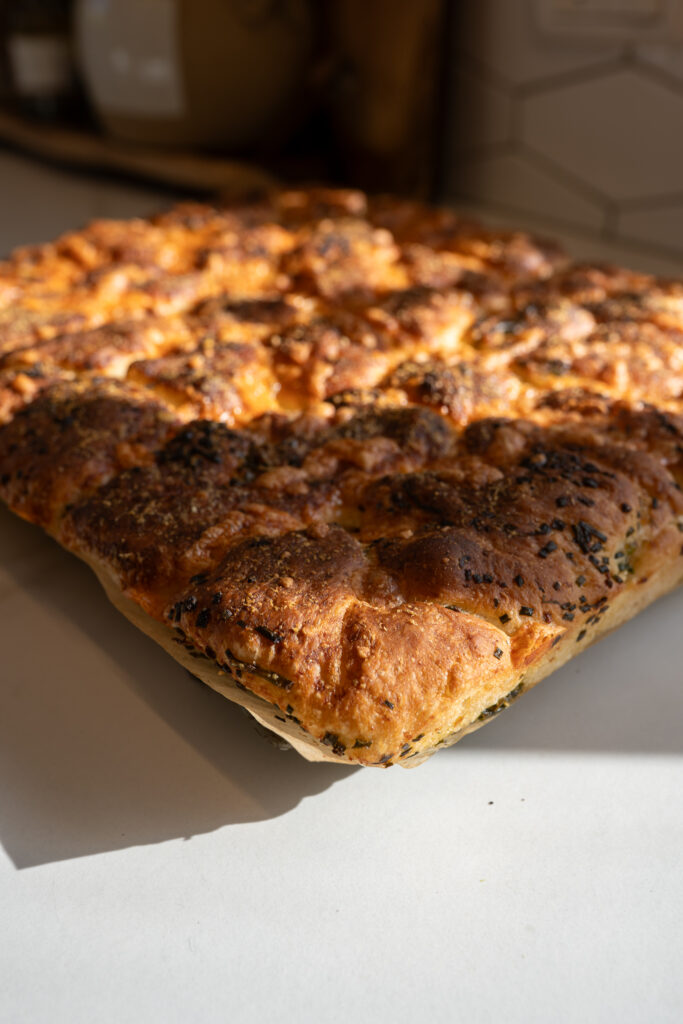
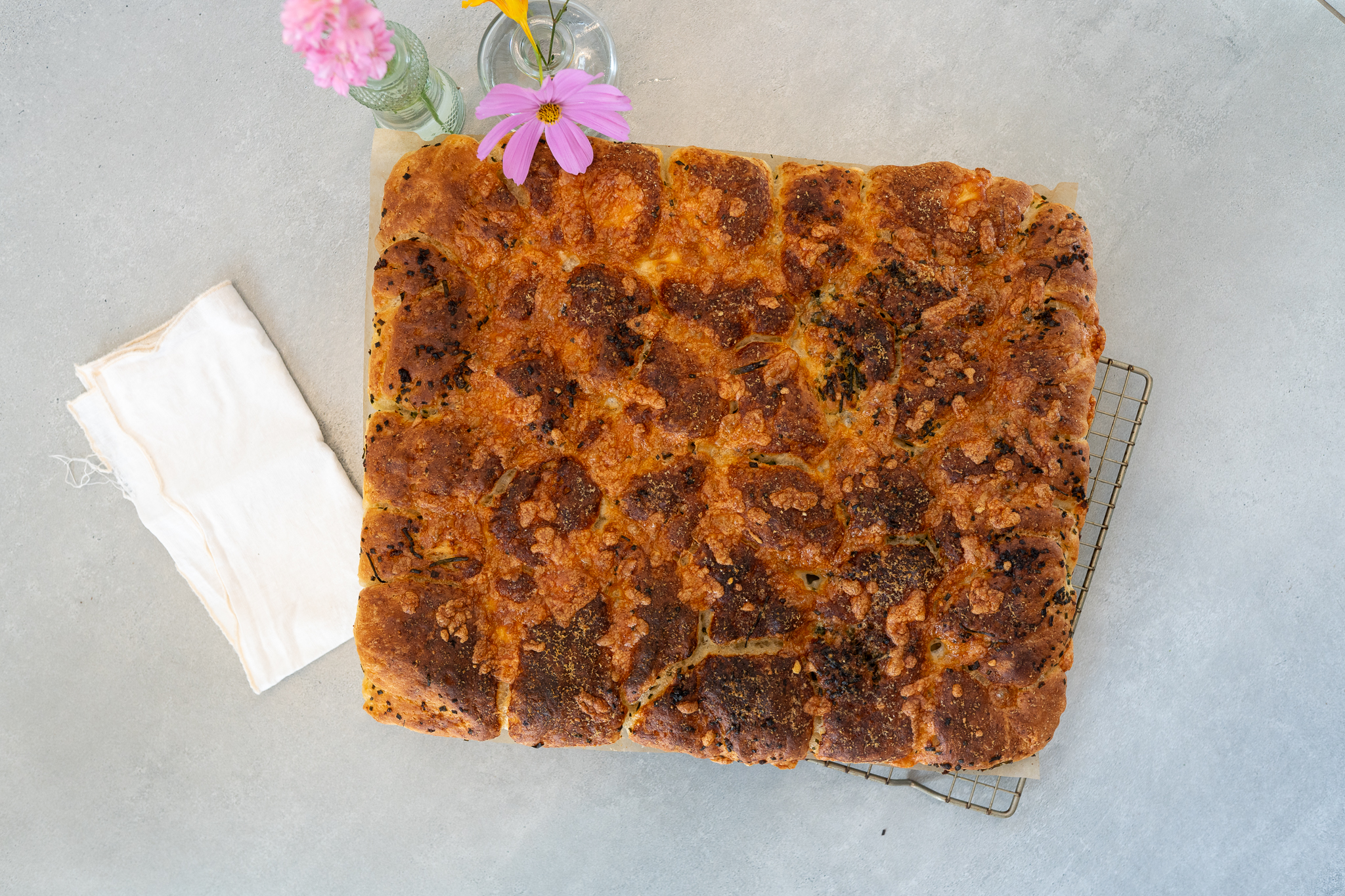
Each dough square gets dipped into a mixture of garlic butter and chopped chives (and yes, this is where the kitchen starts to smell amazing). Lay them side by side on a parchment-lined baking sheet. Keep going until the tray is full of golden, garlicky, butter-drenched dough cubes.
At this point, it already looks (and smells) like something special — and it hasn’t even gone into the oven yet.
Ingredients
Method
- Mix all the dough ingredients — except the butter and garlic — until the mixture is uniform, with no dry flour or puddles of water. Cover and let rest for 30 minutes.
- After 30 minutes, perform a set of stretch-and-folds, then cover the dough again.
- Wait another 15 minutes, and repeat the folding process.
- Grate half of the frozen butter over the dough, add the minced garlic, and do another round of folds.
- Wait another 15 minutes, grate the remaining butter into the dough, and fold again.
- Let the dough rise for about 1 hour, or until doubled in volume.
- Toward the end of the rise, melt the butter in a skillet together with the minced garlic. Be careful not to burn the garlic — you’re looking for a fragrant, buttery garlic infusion.
- Stir in the chopped chives and mix well.
- Transfer the dough gently to a well-oiled surface, trying not to deflate it.
- Oil a bench scraper or sharp knife, and cut the dough into pieces roughly 5×5 cm in size.
- Dip each piece into the garlic-chive butter mixture and place it on a baking sheet lined with parchment paper.
- Repeat until the tray is filled with coated dough pieces.
- Lightly cover the tray with oiled plastic wrap and let the dough rise again for about 1 hour.
- Sprinkle the grated cheeses over the dough, and bake in a preheated oven at 220°C (430°F) for 20–25 minutes, until golden and bubbly.
Nutrition
Notes
Tried this recipe?
Let us know how it was!Discover more from Tals Cooking
Subscribe to get the latest posts sent to your email.